Lesson 14: Emotional Freedom Technique Part IV

The perfect metaphor “The Writing on our Walls.” This is, “events in our lives create our beliefs about the world, and how those beliefs can either pose limits or open new possibilities. We live in a Palace of Possibilities.

Welcome to Part IV of Emotional Freedom Technique. If you would like to read the first article, please review Emotional Freedom Technique, Emotional Freedom Technique II and Emotional Freedom Technique III.

Keep in mind that EFT is not intended to replace qualified medical or psychological treatment. Before practicing EFT, please be sure you are doing so with the advice of a qualified medical or mental health professional.

Gary Craig has been a student of personal improvement and human behavior since he was a teenager. His journey has exposed him to a wide variety of theories about why people have the challenges they face and what it might take to overcome them.  He has personal experience with all of the theories, and has experimented with his own version of those theories for decades.

Eventually he came up with a perfect metaphor that makes sense and he refers to it as “The Writing on our Walls.” He explains this as, “events in our lives create our beliefs about the world, and how those beliefs can either pose limits or open new possibilities. We live in a Palace of Possibilities.  It is an ever expanding structure, filled with awesome rooms and annexes that are loaded with achievements and joy. These rooms are open to everyone, although most of us only visit a few of them. It’s not that we are barred from any of the rooms. Rather, it’s that we choose to dwell only in those rooms within which we are comfortable. Somehow, we don’t belong in those other, more expansive rooms. They are for others. They are for richer people and more privileged people and people with more talent than us. We stay within the familiar (our comfort zones) and don’t venture beyond the walls (limits) of the rooms we have chosen. Why? Because our can’s and can’ts are written on those walls and we obey those dictates as though they were real. They are reflected in our careers, our incomes, our relationships, and even our self image. In fact, there is scarcely any part of our makeup that is not affected by what’s written on those walls.”

He goes on to explain that the words on our walls are metaphors for our self talk. These words represent the attitudes, opinions & beliefs that we have accumulated over the years. Many of them are hand-me-downs from our parents, grandparents, teachers, coaches, church’s, peers, books, TV and an endless list of other “authorities” in our lives. Upon investigation many of them are laughable, nonetheless, they still seem to hinder our progress.

We all have different words on our walls and this is why we appear to have different limits. Your limits are different from my limits because the “truths” written on your walls are different from the “truths” written on mine. However, they are not really “truths” at all, only guidelines we have adopted for getting through life … AND … many of them are fictions.

We continually consult the writing on our walls

That writing is our most leading advisor and we consult it all day long. And why not? It represents every experience we have ever had. It contains all of our “how to’s”, our can’s & can’ts, our should’s & should not’s as well as our must’s & must not’s. It contains our personal version of what is right or wrong, our judgements, our successes and failures in this world. “It’s all there …  everything we hold to be true … written on our walls.”

Those words on our walls tell us about our opportunities or our limits … and often they are very conflicting words. The opportunity voice will say ” here is an opportunity – go for it!” Whereas our the limits voice will say:

“I am are too young (or too old) for that.”
“I don’t have enough education.”
“I don’t have enough experience.”
“People who take risks end up broke.”
“Rich people are dishonest.”

And the list of our limited beliefs go on and on. If you believe any of these limited beliefs, you may have bought into an expensive “limit” that need not be there.

So consider this…

You consistent thoughts become you reality.

The main goal of psychotherapy is to change peoples consistent thoughts so that the quality of their lives (their reality) will shift for the better. The primary goal is to get people to think differently about their traumas, fears, guilt, grief, limited beliefs etc. in hopes that they will put these things “in perspective” and go about their lives more positively. Their consistent thoughts, once changed, become their new reality.

Many people are unaware of “The Palace of Possibilities” in which they live because they dwell in their own personal dungeons amidst their thoughts of past abuses, war memories, fear, guilt and their limited beliefs. Their continual thoughts have become their reality, and when they walk into a therapy office, they bring their dark dungeons with them. The writing on their walls provides graphic evidence of their personal guilt, shame and emotional turmoils. The other writing on the wall of a positive nature is defiantly there, but is completely overwhelmed by the negative writing.

The moral of the story is that you have become a lifetime of “limits” and will continue to do so until that writing is erased and replaced.

This may be a cognitive sort of approach, but what will take us to new level is a combination of these tools with EFT. Once we erase the limited beliefs from our walls, we are free to replace them with whatever we want … and the result is freedom from those limits.

Adding New Information To Our Walls

There is an old saying that goes, “Nothing has any meaning except the meaning we give it.”

So what happens when there is no writing on our walls? How do we make sense of blank or clean walls with no information on a subject? Its Simple! You make up a meaning that fits as closely as possible within the “truth” that is already written on your walls. The resulting “meaning” is probably fictitious, but will not stop you from doing it. It is a human need to make meaning and sense of the world around us. People who attend therapy are constantly filling in the blanks to make meaning of the world around them. Listening to people trying to fill in the blanks leads to big clues regarding core issues.

There is true peace and freedom involved in fully recognizing what we do with the writing on our walls. This leads to better understandings and forgiving attitudes. It helps us to stand back from disagreements and de-personalize ourselves from other people’s actions. After all, they’re just spouting off what is written on their walls.

Incongruent Writing On Our Walls

The writing on your walls are there to help you navigate through uncertainty. It helps you make “formed” choices and decisions. It helps you avoid danger to keep you safe. To challenge the writing on someone’s walls is to use a technique called Affirmations. This is a positive thinking technique, for example, your goal is to lose weight or find a new job. You then design a statement or affirmation that assumes your goal has become a reality.

  • I will loose 10 pounds.
  • I will earn more money and find a new job.

Affirmations conflict the writing on your walls. It affirms a reality that is currently not true. Here’s an example, a 200 pound woman uses an affirmation aimed at weighing 130 pounds. Her affirmation might be:

“My normal weight is 130 pounds.”

As a result, you end up with “tail enders” at the end of her affirmations. They might go like this:

  • “But if I lose the weight, others will expect me to keep it off.”
  • “But if I lose the weight, I will have to spend a lot of money for new clothes.”
  • “But if I lose the weight, men will hit on me and expect sex.”
  • “But if I lose the weight, men may not hit on me and then I will know I’m not loveable.
  • “But if I lose the weight, I will have to give up my favorite foods.”

Again, this list of tail enders are never ending. These are existing obstacles for losing weight.  They are the “yes, buts” and, in fact, represent the true affirmation.  This is why affirmations don’t work well in practice, despite the persuasive logic behind them. They are typically followed by the opposing tail-enders that always has the last word. Your tail-enders always win the argument and keep you right where you were before the affirmations. If you are an EFT Practitioner treating someone who wants to lose weight, knowing these dynamics can save you a lot of time.

More importantly for the EFT process, Tail Enders often point directly to the Specific Events that contributed to those beliefs. To carry on with weight examples, consider these explorations:

  • “If others expect you to keep the weight off, how do you know that? Did someone say that to you? Maybe someone’s parents made it clear over and over that once you achieve something you must never let it go, or maybe there were peers in school who judged someone who had lost weight then put it back on.”
  • “If men will hit on you and expect sex, what is wrong with that? Was there a time when having sex was uncomfortable for you? Have you ever felt pressure to have sex? Maybe there were uncomfortable dating experiences or unreasonable pressures to have sex. Finding those Specific Events will go a long way toward getting deeper results with EFT.”
  • “If losing weight means you will have to give up your favorite foods, was there ever a time when you were deprived of food? Or when snacks were taken away as a punishment? As soon as you find a Specific Event, head straight for the Tell the Story Technique to release that disruption.”

In most cases when someone reveals their objection to reaching a goal, it represents a fear or a memory of discomfort. Those Specific Events can usually be revealed by asking “what does that remind you of?” or some variation thereof.

If we listen to ourselves talk, we can hear our “limits” and other forms of affirmations come rolling out, like:

  • “I can’t sing,”
  • “Making money isn’t spiritual,”
  • “Women can’t compete in a man’s world,”
  • “I never seem to find the right words,”

Here are a few more examples of the writing on our walls:

  • “Salesmen are pests.”
  • “Rich people are greedy.”
  • “Profits are bad.”
  • “Diets don’t work.”
  • “Men don’t cry.”
  • “Nice girls don’t do that.”
  • “No pain, no gain.”
  • “Good people work for free.”

Taking the writing on our walls a few steps further by adding a framework in which you can organize all the pieces of peoples issue. Putting this skill into practice will allow you to see the overall picture more clearly and choose more powerful skills to develop.

The “truths” on people’s walls were put there by the Specific Events from their past.

Identifying Truths

When describing your issues, looking for writing on your walls and try to discover how your inner world is put together. You may or may not know or probably cant explain it. The better you are at working with input, the better you will get to the bottom of your limits.

In general, once you have finished your description, the first thing you want to know is “Why?”…why do I feel this way, why am I in this situation, why do I continue to behave this way?

When you have explored deep enough to reveal the “Truths”, or writing on your walls, you can see what may be driving your behavior, or coloring your perception, and then you can start breaking that into Specific Events.

Here are some examples to help you with this idea.

General Conversation                              “Truths”

“I don’t enjoy my job”                      vs        “My coworkers don’t like me”

“My husband is critical”                  vs        “Nobody appreciates me”

“I just can’t lose the weight”           vs        “I need food to relax”

“I can’t let go of my ex”                  vs        “If I let go, then he wins”

“I take care of everyone but me”  vs        “I’m not valuable any other way”

Each person will present a different set of experiences which will have a list of different questions. However, these “truths”, beliefs, or writing on the walls can be identified as follows:

  • Look for a conclusion, “Truth”, or general belief that you have about yourself or the world (e.g. I’m not smart enough, women can’t be successful in business, etc)
  • Look for a general fear (e.g. afraid to be thin, fear of rejection, fear of being alone, etc)
  • Look for something that points directly to a collection of Specific Events (e.g. people don’t like me, I hate school, I can’t drive at night, etc)

These aren’t the only qualities that define the writing on the walls, but they will certainly get you off to a good start. The first two are really strong clues, but the third one is mandatory because:

If you can’t see Specific Events behind your issue, then you need to keep digging.

Depending on the person, you may need to do some general tapping before you can get to the writing on their walls.

Addressing “Truths” and events from earlier in life will make a bigger difference.

If you always catch the red robots while driving, you might eventually conclude that you “always catch the red robots.”  At that point, you have constructed a tabletop, supported by all the times it was true. From there, you will expect to catch the red robots, so you will look for evidence to support your conclusion, and continue to add “Legs” to support the tabletop. Even when you went through a green light, you would consider that to be an exception to the rule and consider yourself “lucky this time,” which also supports the above conclusion. When addressing the issue of “I always catch the red robots” by simply removing the intensity of each table leg one by one, that conclusion, “Truth,” or tabletop, eventually collapses.

This tabletop was created earlier in life, it sits deeper in your system than some of the others, and probably directly underneath the more recent similar experiences.

In the diagram below, you will see that if you collapse all the legs under the more recent tabletops, they would simply land right on top of the earlier tabletop. Further, as long as the deeper issue is still intact, you would continue to erect new legs for the smaller tables, or build a few new tabletops in the name of “I always do it wrong,” using the experiences to come. That’s because you still expect to “do it wrong,” so your system will find ways to make that true. This big, deeper tabletop is called a Core Issue, and ultimately, those are the ones we want to collapse.

It is tempting to blame others, or outside circumstances, for our emotional states but, in reality, the true blame lies within. If we are harboring anger, guilt or fear, for example, it may seem like someone or something outside us is causing it but, in reality, these emotional states are internally generated, they are “inside jobs.” Thus if two people see a snake, one may be calm about it while the other has a phobic response. It isn’t the snake that caused these emotional states, it’s the inside job of the people involved.

The other half of this twin mindset says, “it’s not what happens to you, it’s your response that counts.”  This is, essentially, the same thing. It’s just another way to approach it verbally and thus better cement the concept. This will move your sessions along much more rapidly.

According to the writing on our walls, one person’s truth is not necessarily someone else’s. That means…

…there is no “one real truth.”

There are 5 parts to the Emotional Freedom Technique, this is part IV, if you enjoyed this article, click follow to get Part V automatically when its published.

Stay Connected! Join Our Many Subscribers!

Processing…
Success! You're on the list.

Privacy Policy

Sources

For more information visit: http://www.emofree.com

Lesson 11: Emotional Freedom Technique Part II

Emotional Freedom Technique Part II
Imagine how different the world would be if everyone cleared out the garbage from their past.

Photo by nicollazzi xiong on Pexels.com

Emotional Freedom Technique continues, in this section the discussion is emotionally weeding your garden with a weed whacker, i.e., you can get a lot done quickly but most of it is temporary.  You may succeed in cutting off the tops of the weeds, but the roots remain deep underground, they keep growing, spreading and building new weeds to show up another day. Everyone is different and experiences different emotional gardens that contain weeds specific to them. Can you imagine what it would feel like to truly be at peace with everything that has ever happened in your life? How about being at peace with half of it? Even that would make an enormous difference for most people. Imagine how different the world would be if everyone cleared out the garbage from their past. Not only would we all feel better physically and emotionally, but we would also be able to understand each other and feel compassion without any issues being in the way.

HOW TO GET TO THE ROOT

The main thing is to start off with some emotional issue(s) that is bugging you at the moment. Here are 3 questions you can ask yourself to help you get started:

  1. What is the biggest cause of stress in my life right now?
  2. What was happening in my life the time the issues started?
  3. What do you constantly complain about?

True emotional health is not a quick fix, the tapping approach is different from traditional health care, EFT is expected to keep improving your emotional health until your issue responds.

You may feel more intensity to your overall issue, as it may seem that “EFT didn’t work very well”, in reality, some aspects may have already been resolved, but the intensity you feel may be coming back from aspects that remains. You need to make sure that all the aspects have been resolved, this entails “weeding”.

No matter what area of your life seems blocked, there will be individual aspects triggering the intensity you feel towards certain situations. Visualizing these situations can be a great way to trigger all aspects and bring them to the surface.

As new aspects come to the surface, address each of them as separate problems and bring down the intensity to zero. Remember to measure your intensity before and after each tapping session to keep track.

EFT can be like peeling layers of an onion, as you resolve one layer, the next one is right there underneath it. The different aspects in a story can lead you to be sad, then angry, maybe disappointed, all of these are new aspects in your issue and need to be resolved individually.

You may need to clear all aspects before you gain relief, for example, you may have a simultaneous headache, back ache and toe ache. The pain may seem to shift from one ailment to another.  It is, nonetheless, still pain, so you may need to get all three ailments to zero before you feel healthy again.

Tracking aspects pertaining to one issue may be beneficial if the issue arises again, this again could be aspects that are unresolved.

Explore an emotional issue of your own, break the issue into smaller parts, first start with the issue that is giving you the highest intensity. Use the EFT Tapping Basic Method on each aspect and notice for signs of switching aspects. The more specific you get, the greater and more precise your results. Dig deeper and get specific with the location, size, shape, sensation, temperature or colors.

Here is an example of how to uncover aspects, watch here

Tapping For Pain

If you look at EFT tapping for e.g.  “this headache”, try and target this more specifically, by looking at specific information as (front, back, top, is it a sharp or dull pain or just a throb). Now you can target your issue specifically, for example, “Even though I have this sharp pain behind my left eye…”.

Here are the three most common signs of an aspect switch when using EFT Tapping for physical symptoms.

  • Pain moves to a new location
  • Pain changes in quality (different size, sensation, shape, etc.)
  • Pain increases in intensity

Here is an example of EFT Tapping for physical pain, watch here

Tapping For Emotion

When working with emotional issues, we often target emotions like nervousness, anger, or fear, and it is very useful to observe those sensations as they change. If, for example, you are working on a relationship issue with your partner and the problem is that you feel that your partner is too demanding, you could start by tapping on “Even though my partner is demanding…”

This a very global approach. The real problem is your response to your partner being too demanding, being more specific would mean targeting your feelings of ‘higher standards’ or ‘how to appease’. You can then be more specific by saying “Even though I feel burdensome when he/she is too demanding …”

How would you go about resolving a social anxiety issue? Different people or situations trigger anxiety in different ways. Break down your social anxiety into smaller parts.

  • Why is it harder to be in this situation compared to being at work?                                 
  • Why is it harder to be in this situation than being around your family or friends?               
  • Is there something you are not comfortable with about being with strangers?                 
  • Are you more nervous around being with men or women?                                               
  • Are you afraid that something will happen?                                                                       
  • Are you scared of crowd?

You can now test this situation by going into a social gathering and see if you are less and less anxious each time. This concept can be applied to any emotional issue, if you are having issues and you feel you are not getting any progress, there are EFT professionals trained to help and streamline the process for you. Testing is the strongest tool for actively digging up extra aspects and confirming that your work is complete.

You will not always be accurate in your 0-10 assessment; this is a benchmark to compare before and after intensities. We often subconsciously give the inaccurate number because (1) you may never have been this low before in your assessment and are not sure on how it feels to be at or near zero, (2) you may not believe you’ve actually achieved this relief or (3) you may not believe it will last. With experience, you will be able to determine when you are doing this. Be careful when assessing your emotions that you are not confusing your emotions with the whole issue versus one aspect of the issue?

Vivid Visualization

Make sure you are not ‘thinking’ about the issue but actually step into the situation, if that doesn’t give you any remaining intensity, then turn up the volume, make everything bigger, exaggerate all the sights, sounds, colors, sizes and really try to feel your emotions. Once you succeed, you can now address your aspect(s). Don’t tip-toe lightly around your issue or look at yourself in the situation as if you are watching a movie. This is called dissociation, and it avoids you from really experiencing the moment.

Testing vivid visualization, watch here

Using Props

You can use props when performing EFT by using photos, memorabilia, sounds, movies and the like. This is a useful substitute for those times when testing in the real situation is not possible. The idea here is to trigger emotional issues and observe what aspects or challenges arise.  Example, you may (1) view a photo to test your level of grief, (2) play the sounds of gunfire or music to test traumatic responses, or (3) view a movie about snakes if you wish to test your tapping progress regarding a fear of snakes.

Testing using props watch here

Testing In The Real Situation When Possible

This is the ideal test as it provides the likelihood for exposing remaining aspects on related issues. While visualizing an issue can go a long way toward uncovering real situations that will often present aspects you couldn’t have anticipated, the real situation is the best solution.

Testing the real situation video, watch here

Tabletop

Table legs support a tabletop, if you remove the table legs the tabletop falls. “Let’s explore the globally stated, “I’m afraid of rejection”,

  • “Even though my 3rd grade teacher embarrasses me in front of the class…..”               
  • “Even though my father is not at my high school graduation, and I feel left out….”       
  • “Even though my high school sweetheart says, ‘I’ve grown tired of you’….”                   
  • “Even though I am sent to my room for the whole day on Thanksgiving at age 8….”   
  • “Even though Mom tells me ‘You’ll never get married unless you are thin like your sister’….”
  • “Even though I am cut from the Little League baseball team….”

Each of these rejections gets stored and as the disruptions accumulate, it causes someone to avoid rejection at all costs. This might affect choices or chances they are willing to take in life, and someday they will realize they have limited themselves because they are “afraid of rejection.” This is the foundation of the problem; the fear of rejection is the symptom. When each leg is removed, it destabilizes the tabletop until the table eventually collapses. The earlier events in your life have the best chance of being foundational events, it’s better to knock out the biggest issues first. “The farther back you can go in your personal history to find a related event, the bigger that leg is likely to be.” Some common themes come out while resolving aspects.

Knocking the legs off the Table example watch here

Relate Into A Story

  1. Revert the scenario into a short “movie” replayed from the past, preferably as far back as childhood, choose a few events
  2. Give your movie(s) a title in the present tense, example, “the moment…”
  3. Make your movie(s) 1-3 minutes long
  4. It should contain at least one emotional crescendo
  5. It should have a beginning, end, plot, and characters
  6. Beside each movie title, rate the intensity of each event from 0-10. Examples:                      The moment my mom hits me in the kitchen (8)                                                                 The moment I am stealing Paul’s lunch (5)                                                                          The moment I almost fall down the stairs at Monica’s party (7)                                          The moment my fourth-grade teacher shouts at me in front of the class (8)                      The moment brother locks me in a closet (7)
  7. Neutralize the most intense aspect(s) first, cross them off the list and look for the next most intense ones. Some additional events may come into mind as you tap. Add the new events to your list and address them accordingly.
  8. After a few events, namely 5 or so, go back through your list and re-evaluate the intensity rating of each item. The events should become less and less intense.
  9. If you clear one specific event per day, in 3 months you will have resolved 90 events. Can you imagine how much better you would feel and how you could improve your life.

Here are some specific questions within the tapping process

  • When was the first time you felt unloved?
  • Is there a major guilt experience we can discuss?
  • What event in your past does this issue about ______ remind you of?
  • What was your most fearful/abusive/traumatic experience?
  • Was there an emotional event preceding the onset of your illness?

Specific Events vs. Specific Emotions

Emotions do not cause the specific events. There is no such thing as a specific emotion as we commonly use terms like fear, anger and grief as though they were specific items, but these are generalized labels. “Grief over the death of a loved one, for example, isn’t just a form of sadness. If you look behind it, you will often find things like the fear of being alone or guilt for what the griever did or did not do while the deceased was alive. I once sat down and made a list of 50 emotions and could easily define all of them in terms of fear e.g., hand washing OCD can be defined as the fear of germs, guilt can be defined as the fear of being found out, depression can be defined as the fear of being worthless … and on it goes. Take the edge off: Before actually telling the story, check out any intensity you may have about actually doing the narration. If your intensity is at 5 or above, it is worthwhile to do a few global type rounds of The EFT Basic Method to take the edge off.”

“Even though I’m nervous about telling the story…..”
“Even though I’m afraid of what might happen when I tell this story….”
“Even though I don’t like this whole thing…..”
“Even though just starting the story gives me the jitters….”

You can also use your physical symptoms when you tap namely:

  • Even though my heart is pounding …
  • Even though my palms are sweaty …
  • Even though I have a headache …
  • Even though my stomach is tight …

How to Tell the Story

It’s best to tell the story out loud. Start at the beginning of the story at a neutral point. Stop telling the story when you feel any intensity. At each stopping point, step into the moment, as you use the EFT Basic Method to address each emotion and intensity, once they are released, continue the story to the next intense moment. If you don’t stop when intensity arises, you are likely to go right by an important healing opportunity. If you are working with a history of abuse or trauma, you may want to consider working through with an EFT professional.

Telling the story, watch here

You might not be zeroing past events immediately, but you will be making progress.  You will feel this by personal peace in your life. Chemical causes such as those propounded by the medical model, drugs and proper nutrition can be vital. Always consult your doctor before using EFT. If your traumatic event is so intense that you are afraid to go through it on your own, you should seek help from a qualified professional in EFT.

As you eliminate the emotional baggage from your specific events you will, of course, have less and less internal conflict for your system to deal with. Less internal conflict translates into a higher level of personal peace and less emotional and physical suffering.

There are 5 parts to the Emotional Freedom Technique, this is Part II.  Click here to go to Part III

Stay Connected! Join Our Many Subscribers!

Processing…
Success! You're on the list.

Privacy Policy

Lesson 9: EFT Tapping: Emotional Freedom Technique

Healing tool to assist in improving our daily life’s. EFT address’s distressed memories to restore the body’s flowing energy and replaces negative emotions.

“The cause of all negative emotions is a disruption in the body’s energy system.” by Gary Craig

Gary Craig is the founder of Emotional Freedom Technique also known as EFT, Tapping or EFT Tapping. This technique is a healing tool to assist in improving our daily life’s. This technique dissolves our emotional issues to improve physically, emotionally, mentally, environmentally, intellectually, occupationally, socially and spiritually.  EFT is borrowed from the Chinese meridian system, Gary explains “EFT combines the physical benefits of acupuncture with the cognitive benefits of conventional therapy for a much faster, more complete treatment of emotional issues, and the physical and performance issues that often result.” EFT does not use needles, rather a simple two step method involving:

  1. mentally “tuning in” to a specific issue(s) while
  2. stimulating certain meridian points on the body by tapping on these points with your fingertips.

EFT appears to balance disturbances in the meridian system, if done correctly, thus reducing conventional therapy procedures from months or years down to minutes or hours. This technique is very easy to learn and can be done anywhere, anytime with impressive do-it-yourself results.

Energy courses through your body and it is invisible to the eye, this energy flows within your meridians. By simply tapping near the end points of these energy meridians, you can experience profound changes in your emotional and physical health.

Be careful of the many EFT programs out there that claim to be a legitimate alternative, do your homework before investing in any of these programs.  Always consult a doctor before you practice EFT.

Introduction video to EFT, watch here

EFT respects the memory but focuses on addressing the true cause of your issues. Many people believe their memories are the root of their problems, but EFT doesn’t require you to relive past traumas to find relief. While painful memories may come up during the process, there is minimal suffering involved.

Negative emotions are often triggered by distressing memories that disrupt the body’s energy flow. EFT works by addressing the distressed memory, restoring the body’s energy, and replacing the negative emotion. This leads to rapid relief by directly addressing the root cause of the issue.

EFT Discovery statement, watch here

The EFT tapping process consists of five simple steps that should be followed in order. The technique focuses on a 9-point tapping sequence, which works with 12 meridians and 2 governing vessels. These pathways are interconnected, sending balancing energy through one pathway that influences others. This is why addressing just a few key pathways is enough to bring balance. Once you identify the issues, tapping stimulates the energy pathways, allowing the energy to flow freely. After you’ve memorized the process, it can be done in about 30 seconds.

Positive Outcomes Include:

  • Many soldiers report that their PTSD symptoms, nightmares, and intrusive thoughts have faded after using EFT.
  • Some phobias, such as fear of public speaking, spiders, or heights, have been completely eliminated in just a few minutes and never returned.
  • Various types of pain, including headaches, often experience partial or complete instant relief.
  • Professional therapists have found that EFT allows them to achieve deeper, faster, and longer-lasting results with clients.
  • Cravings, including for sugar, alcohol, cigarettes, and shopping, can subside. When you feel a craving, performing EFT can help. Remember, cravings are a lighter form of addiction, and deeper issues may need to be addressed if you’re dealing with substance dependencies.
  • Some athletes report improved, sometimes dramatic, performance.
  • Many people with serious illnesses experience partial to complete symptom relief. EFT has helped with a wide range of issues where emotional or energetic factors are involved. While success varies and not everyone finds relief, the theory is that unresolved stress or emotional issues over time may make our bodies more vulnerable to disease, so it’s always recommended to clear as much of that stress as possible.

To address emotional issues like anger, relationship problems, workplace stress, low self-esteem, and anxiety, focus on the emotions tied to the issue. Identify what makes the situation intense and use tapping to release those emotions.

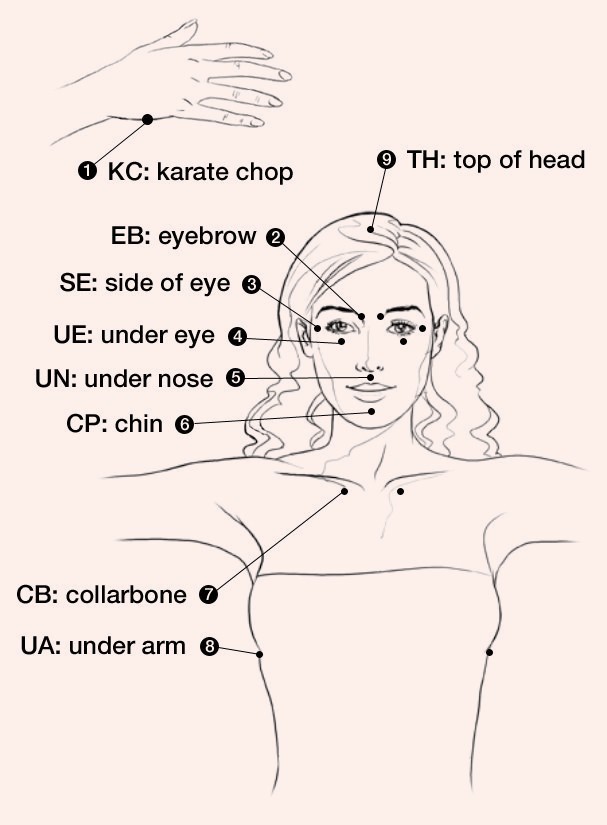
The EFT Tapping Points

Tapping out anxiety with EFT tapping | West Orange Times & Observer

KC: (Karate Chop). This is located at the center of the fleshy part of the outside of your hand (either hand) that you would use to deliver a karate chop.

TOH: (Top of the head). This point is halfway between your ears and the center of your nose to the middle of the back of your head.

EB: (Eyebrow). At the beginning of the eyebrow.

SE: (Side of the eye). On the bone bordering the outside corner of the eye.

UE: (Underneath the eye). On the bone under the eye about 1 inch below your pupil.

UN: (Under the nose). On the small area between the bottom of your nose and the top of your upper lip.

Ch: (Chine). Midway between the point of your chin and the bottom of your lower lip.

CB: (Collarbone).  To locate this point, first place your forefinger on the U-shaped notch at the top of the breastbone (about where a man would knot his tie). From the bottom of the U, move your forefinger down toward the navel 1 inch and then go to the left (or right) 1 inch.

UA: (Under the arm). On the side of the body, at a point even with the nipple (for men) or in the middle of the bra strap (for women). It is about 4 inches below the armpit.

Some Tapping Tips

  • Tapping points are the same on either side of the body. You only need to tap one side of these twin points. However, if you have both hands free you can tap on both sides for good measure. You can also switch sides when tapping these points.
  • The Tapping is done with two or more fingertips. This is so you can cover a larger area and thereby ensure that your tapping covers the correct point. Most people use their dominant hand to tap.
  • You tap approximately 5 times on each point. No need to count the taps because anywhere between 3 and 7 taps on each point is adequate. The only exception is during the Karate Chop Point which is tapped continuously while you repeat standard wording.
  • The process is easily memorized. After you have tapped the Karate Chop Point, the rest of the points go down the body in sequence as per the diagram above.

The 5 Basic Steps

  1. Identify the issues (This is a mental note of what is bothering you, this could include, sore throat or I was embarrassed at my friend’s birthday party, when I fell down the stairs.  Only target 1 issue at a time. This issue needs to belong to you, your focus and your reactions. The language that we use always aims at the negative as it is the negative that creates these energy disruptions. Other conventional methods promote positive thinking, EFT aims at the negative to neutralize and the natural positives to bubble up to the top).
  2. Initial intensity (This is the intensity you feel on a scale of 0-10, 0 being no feeling or 10 being the worst feeling. This is so that you can compare your progress later. On a scale of 0-10, how sore is your thought or how embarrassed were you at the party, when you fell down the stairs)
  3. The setup (This is your simple phrase. This wording is an essential part of the process because it tells our system what we are working on. You can use some flexibility when using these phrases. The phrase has 2 parts:                                                                             a) the issue(s)                                                                                                                         b) accepting yourself in spite of this issue                                                                                We do this by saying:  “Even though I have this _______________, I deeply and completely accept myself” , “Even though I have a sore thought, I deeply and completely accept myself”, “Even though I was embarrassing at my friends birthday party, when I fell down the stairs. I deeply and completely accept myself”.
  4. The sequence (This sequence involves tapping each point shown in the diagram above while repeating the first part of your phrase in step 3. Start by tapping your KC point while repeating your phrase. Then move onto the other 8 points while repeating “This sore throat”. (You don’t need to repeat the full phrase for the other 8 points)
  5. Test the intensity again (After the sequence, test the level of intensity again assigning a number from 0-10. Compare this number to the number in the first step and see how much progress you have made. If you are not down to zero, then repeat the process until you either achieve zero or plateau at some level.  Otherwise, you will likely need to “get to the roots of the issue”. (This is discussed in Emotional Freedom Technique Part II)

The 9 Point Tapping Sequence:

Phrase: “Even though I have a sore throat, I deeply and completely accept myself.”

Karate Chop (KC) Tap this part of your hand 3-7 time while repeating ” Even though I have a sore throat, I deeply and completely accept myself.”

Then move onto the other 8 points while repeating “This sore throat”. Again, you don’t need to repeat the full phrase for the other 8 points.

Top of the Head (TOH)
Beginning of the Eyebrow (EB)
Side of the Eye (SE)
Under the Eye (UE)
Under the Nose (UN)
Chin Point (CH)
Beginning of the Collarbone (CB)
Under the Arm (UA)

Useful methods to Help Access your Issue(s) and Arrive at your 0-10 Intensity Scale:

  1. Emotional issues can be recreated by your memories and assessing your discomforts
  2. Physical issues can be by assessing any pain or discomfort in your body
  3. Performance issues can be by measuring your current performance level to your desired performance level.

It is very difficult to explain this procedure in words and pictures. It may be easier to watch the demonstration here

If you would like to practice, pick an issue that you are having at the moment. As a beginner you may or may not experience relief the first time. Practice makes perfect. 

Practice while watching here

Addressing your issue(s) one piece at a time is easier and far more powerful while being more specific means learning how to separate each issue into individual parts.

Side Note

Some issues may become more intense, this is not a ‘side effect’ of EFT but a natural reaction that would also occur when thinking or talking about the issue(s) (with a therapist, or otherwise). The major advantage of using EFT is the fact that it addresses the underlying emotional disruption immediately. Keep tapping until you feel calm again, take a break, distract yourself for a while, stop thinking about the issue and come back to it later or seek help from someone with professional training in EFT.

Some people report no benefits whatsoever.  This is often because EFT is applied improperly or lack of education. A small percentage (less than 3%) report having some distress as a result of the process.

You now have a permanent tool that you can use for a lifetime.

There are 5 parts to the Emotional Freedom Technique, this is Part I.  Click here to go to Part II.

If you are interested in learning more about EFT, please see below books by Gary Craig:

EFT Manual 

EFT 

EFT For Weight Loss 

EFT WL  

EFT For Sports Performance 

EFT SP  

EFT For Back Pain

EFT BP  

EFT For PTSD

EFT PSD  

Stay Connected! Join Our Many Subscribers!

Processing…
Success! You're on the list.

Privacy Policy

   For more information visit: http://www.emofree.com

Design a site like this with WordPress.com
Get started