


Emotional Freedom Technique continues, in this section the discussion is emotionally weeding your garden with a weed whacker, i.e., you can get a lot done quickly but most of it is temporary. You may succeed in cutting off the tops of the weeds, but the roots remain deep underground, they keep growing, spreading and building new weeds to show up another day. Everyone is different and experiences different emotional gardens that contain weeds specific to them. Can you imagine what it would feel like to truly be at peace with everything that has ever happened in your life? How about being at peace with half of it? Even that would make an enormous difference for most people. Imagine how different the world would be if everyone cleared out the garbage from their past. Not only would we all feel better physically and emotionally, but we would also be able to understand each other and feel compassion without any issues being in the way.
HOW TO GET TO THE ROOT
The main thing is to start off with some emotional issue(s) that is bugging you at the moment. Here are 3 questions you can ask yourself to help you get started:
- What is the biggest cause of stress in my life right now?
- What was happening in my life the time the issues started?
- What do you constantly complain about?
True emotional health is not a quick fix, the tapping approach is different from traditional health care, EFT is expected to keep improving your emotional health until your issue responds.
You may feel more intensity to your overall issue, as it may seem that “EFT didn’t work very well”, in reality, some aspects may have already been resolved, but the intensity you feel may be coming back from aspects that remains. You need to make sure that all the aspects have been resolved, this entails “weeding”.
No matter what area of your life seems blocked, there will be individual aspects triggering the intensity you feel towards certain situations. Visualizing these situations can be a great way to trigger all aspects and bring them to the surface.
As new aspects come to the surface, address each of them as separate problems and bring down the intensity to zero. Remember to measure your intensity before and after each tapping session to keep track.
EFT can be like peeling layers of an onion, as you resolve one layer, the next one is right there underneath it. The different aspects in a story can lead you to be sad, then angry, maybe disappointed, all of these are new aspects in your issue and need to be resolved individually.
You may need to clear all aspects before you gain relief, for example, you may have a simultaneous headache, back ache and toe ache. The pain may seem to shift from one ailment to another. It is, nonetheless, still pain, so you may need to get all three ailments to zero before you feel healthy again.
Tracking aspects pertaining to one issue may be beneficial if the issue arises again, this again could be aspects that are unresolved.
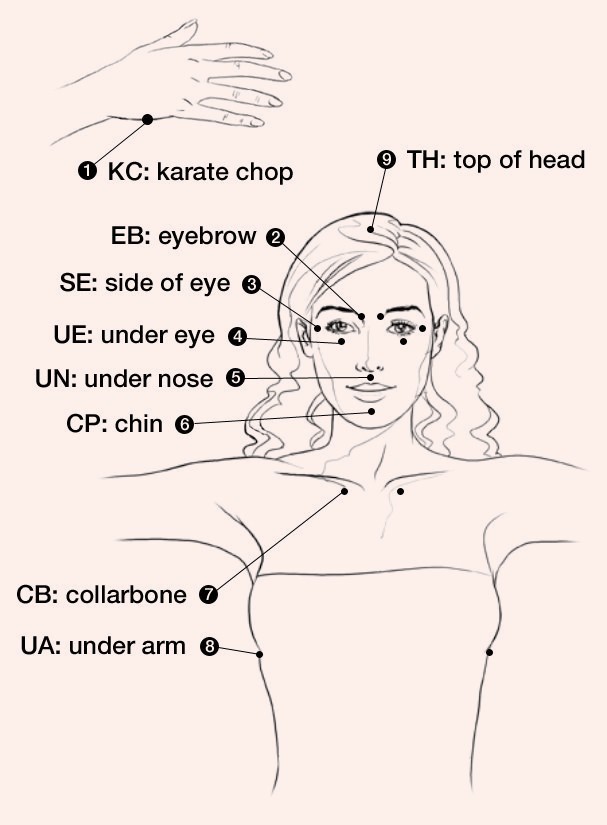
Explore an emotional issue of your own, break the issue into smaller parts, first start with the issue that is giving you the highest intensity. Use the EFT Tapping Basic Method on each aspect and notice for signs of switching aspects. The more specific you get, the greater and more precise your results. Dig deeper and get specific with the location, size, shape, sensation, temperature or colors.
Here is an example of how to uncover aspects, watch here
Tapping For Pain
If you look at EFT tapping for e.g. “this headache”, try and target this more specifically, by looking at specific information as (front, back, top, is it a sharp or dull pain or just a throb). Now you can target your issue specifically, for example, “Even though I have this sharp pain behind my left eye…”.
Here are the three most common signs of an aspect switch when using EFT Tapping for physical symptoms.
- Pain moves to a new location
- Pain changes in quality (different size, sensation, shape, etc.)
- Pain increases in intensity
Here is an example of EFT Tapping for physical pain, watch here
Tapping For Emotion
When working with emotional issues, we often target emotions like nervousness, anger, or fear, and it is very useful to observe those sensations as they change. If, for example, you are working on a relationship issue with your partner and the problem is that you feel that your partner is too demanding, you could start by tapping on “Even though my partner is demanding…”
This a very global approach. The real problem is your response to your partner being too demanding, being more specific would mean targeting your feelings of ‘higher standards’ or ‘how to appease’. You can then be more specific by saying “Even though I feel burdensome when he/she is too demanding …”
How would you go about resolving a social anxiety issue? Different people or situations trigger anxiety in different ways. Break down your social anxiety into smaller parts.
- Why is it harder to be in this situation compared to being at work?
- Why is it harder to be in this situation than being around your family or friends?
- Is there something you are not comfortable with about being with strangers?
- Are you more nervous around being with men or women?
- Are you afraid that something will happen?
- Are you scared of crowd?
You can now test this situation by going into a social gathering and see if you are less and less anxious each time. This concept can be applied to any emotional issue, if you are having issues and you feel you are not getting any progress, there are EFT professionals trained to help and streamline the process for you. Testing is the strongest tool for actively digging up extra aspects and confirming that your work is complete.
You will not always be accurate in your 0-10 assessment; this is a benchmark to compare before and after intensities. We often subconsciously give the inaccurate number because (1) you may never have been this low before in your assessment and are not sure on how it feels to be at or near zero, (2) you may not believe you’ve actually achieved this relief or (3) you may not believe it will last. With experience, you will be able to determine when you are doing this. Be careful when assessing your emotions that you are not confusing your emotions with the whole issue versus one aspect of the issue?
Vivid Visualization
Make sure you are not ‘thinking’ about the issue but actually step into the situation, if that doesn’t give you any remaining intensity, then turn up the volume, make everything bigger, exaggerate all the sights, sounds, colors, sizes and really try to feel your emotions. Once you succeed, you can now address your aspect(s). Don’t tip-toe lightly around your issue or look at yourself in the situation as if you are watching a movie. This is called dissociation, and it avoids you from really experiencing the moment.
Testing vivid visualization, watch here
Using Props
You can use props when performing EFT by using photos, memorabilia, sounds, movies and the like. This is a useful substitute for those times when testing in the real situation is not possible. The idea here is to trigger emotional issues and observe what aspects or challenges arise. Example, you may (1) view a photo to test your level of grief, (2) play the sounds of gunfire or music to test traumatic responses, or (3) view a movie about snakes if you wish to test your tapping progress regarding a fear of snakes.
Testing using props watch here
Testing In The Real Situation When Possible
This is the ideal test as it provides the likelihood for exposing remaining aspects on related issues. While visualizing an issue can go a long way toward uncovering real situations that will often present aspects you couldn’t have anticipated, the real situation is the best solution.
Testing the real situation video, watch here
Tabletop
Table legs support a tabletop, if you remove the table legs the tabletop falls. “Let’s explore the globally stated, “I’m afraid of rejection”,
- “Even though my 3rd grade teacher embarrasses me in front of the class…..”
- “Even though my father is not at my high school graduation, and I feel left out….”
- “Even though my high school sweetheart says, ‘I’ve grown tired of you’….”
- “Even though I am sent to my room for the whole day on Thanksgiving at age 8….”
- “Even though Mom tells me ‘You’ll never get married unless you are thin like your sister’….”
- “Even though I am cut from the Little League baseball team….”
Each of these rejections gets stored and as the disruptions accumulate, it causes someone to avoid rejection at all costs. This might affect choices or chances they are willing to take in life, and someday they will realize they have limited themselves because they are “afraid of rejection.” This is the foundation of the problem; the fear of rejection is the symptom. When each leg is removed, it destabilizes the tabletop until the table eventually collapses. The earlier events in your life have the best chance of being foundational events, it’s better to knock out the biggest issues first. “The farther back you can go in your personal history to find a related event, the bigger that leg is likely to be.” Some common themes come out while resolving aspects.
Knocking the legs off the Table example watch here
Relate Into A Story
- Revert the scenario into a short “movie” replayed from the past, preferably as far back as childhood, choose a few events
- Give your movie(s) a title in the present tense, example, “the moment…”
- Make your movie(s) 1-3 minutes long
- It should contain at least one emotional crescendo
- It should have a beginning, end, plot, and characters
- Beside each movie title, rate the intensity of each event from 0-10. Examples: The moment my mom hits me in the kitchen (8) The moment I am stealing Paul’s lunch (5) The moment I almost fall down the stairs at Monica’s party (7) The moment my fourth-grade teacher shouts at me in front of the class (8) The moment brother locks me in a closet (7)
- Neutralize the most intense aspect(s) first, cross them off the list and look for the next most intense ones. Some additional events may come into mind as you tap. Add the new events to your list and address them accordingly.
- After a few events, namely 5 or so, go back through your list and re-evaluate the intensity rating of each item. The events should become less and less intense.
- If you clear one specific event per day, in 3 months you will have resolved 90 events. Can you imagine how much better you would feel and how you could improve your life.
Here are some specific questions within the tapping process
- When was the first time you felt unloved?
- Is there a major guilt experience we can discuss?
- What event in your past does this issue about ______ remind you of?
- What was your most fearful/abusive/traumatic experience?
- Was there an emotional event preceding the onset of your illness?
Specific Events vs. Specific Emotions
Emotions do not cause the specific events. There is no such thing as a specific emotion as we commonly use terms like fear, anger and grief as though they were specific items, but these are generalized labels. “Grief over the death of a loved one, for example, isn’t just a form of sadness. If you look behind it, you will often find things like the fear of being alone or guilt for what the griever did or did not do while the deceased was alive. I once sat down and made a list of 50 emotions and could easily define all of them in terms of fear e.g., hand washing OCD can be defined as the fear of germs, guilt can be defined as the fear of being found out, depression can be defined as the fear of being worthless … and on it goes. Take the edge off: Before actually telling the story, check out any intensity you may have about actually doing the narration. If your intensity is at 5 or above, it is worthwhile to do a few global type rounds of The EFT Basic Method to take the edge off.”
“Even though I’m nervous about telling the story…..”
“Even though I’m afraid of what might happen when I tell this story….”
“Even though I don’t like this whole thing…..”
“Even though just starting the story gives me the jitters….”
You can also use your physical symptoms when you tap namely:
- Even though my heart is pounding …
- Even though my palms are sweaty …
- Even though I have a headache …
- Even though my stomach is tight …
How to Tell the Story
It’s best to tell the story out loud. Start at the beginning of the story at a neutral point. Stop telling the story when you feel any intensity. At each stopping point, step into the moment, as you use the EFT Basic Method to address each emotion and intensity, once they are released, continue the story to the next intense moment. If you don’t stop when intensity arises, you are likely to go right by an important healing opportunity. If you are working with a history of abuse or trauma, you may want to consider working through with an EFT professional.
Telling the story, watch here
You might not be zeroing past events immediately, but you will be making progress. You will feel this by personal peace in your life. Chemical causes such as those propounded by the medical model, drugs and proper nutrition can be vital. Always consult your doctor before using EFT. If your traumatic event is so intense that you are afraid to go through it on your own, you should seek help from a qualified professional in EFT.
As you eliminate the emotional baggage from your specific events you will, of course, have less and less internal conflict for your system to deal with. Less internal conflict translates into a higher level of personal peace and less emotional and physical suffering.
There are 5 parts to the Emotional Freedom Technique, this is Part II. Click here to go to Part III.
Stay Connected! Join Our Many Subscribers!




 Body of Brilliance